Power & Electrical Multiple Industrial Customers

Low-Voltage Distribution Panel — 3-Phase Busbar Spot Monitoring

T-junctions in LV distribution panels are common failure hot spots.

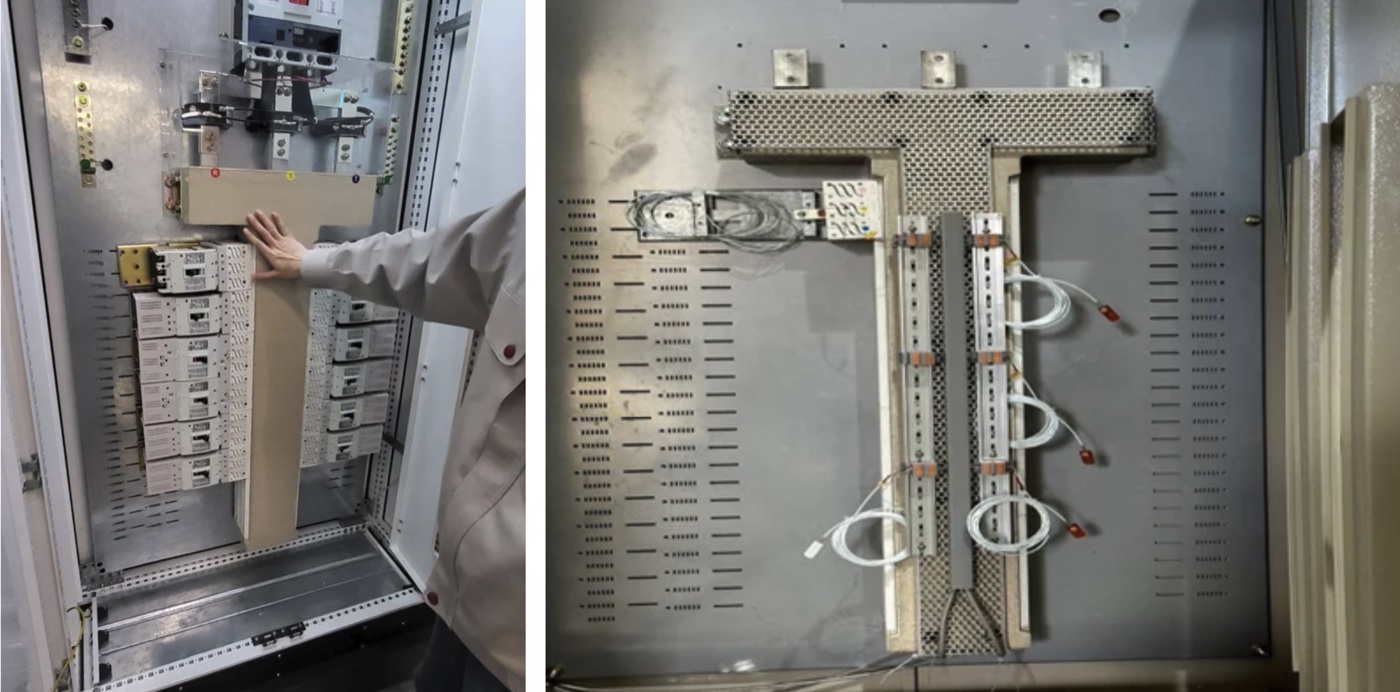
Low-Voltage Distribution Panel — 3-Phase Busbar Spot Monitoring — field installation photo
Multiple Industrial Customers · Power & Electrical

01 The Problem

Across hundreds of factories, the low-voltage distribution panels in the electrical room look identical: rows of breakers, bus bars, and T-shape junctions where three phases come together. Most operators inspect them with a thermal camera once a year — which means anything that goes wrong in the 364 days between inspections is invisible until something burns or trips.

The Risk

T-junctions in LV distribution panels are common failure hot spots.

Detection Gap

Annual IR inspections required shutdown; anomalies between inspections went undetected.

02 The OctosX Solution

We bond Thermalpas sensors at the R/S/T phase junctions inside each panel — usually a dozen sensors per panel. OctosX runs a two-color rule: yellow above 70°C, red above 90°C. The maintenance team sees a wallboard that's almost always green; when a tile turns yellow, they go look.

Sensor & Edge

Thermalpas adheres to R/S/T critical junctions, 24/7 streaming.

Cloud Logic & Alerting

OctosX applies a dual-threshold scheme (yellow 70°C / red 90°C); maintenance crews dispatch by color-coded priority.

03 The Outcome

A typical factory deploys 12 sensors for about $60K per year. Over five years, three of these factories caught anomalies before red threshold — each one preventing roughly a day of downtime worth about $800K. That's the math that makes plant managers stop budgeting for 'annual thermal inspection' and start budgeting for continuous monitoring.

Field Detection

A typical factory deploys 12 sensors at $60,000/year.

Quantified Impact

Over 5 years, anomalies caught before red threshold 3 times, each avoiding ~1 day downtime (~$800,000). ROI ≈ 4,000%.

See it in your plant

Could this case be your plant?

Tell us about your facility — busbars, motors, panels, coal blowers, chillers, whatever your highest-risk thermal interface is — and we'll show you what an OctosX deployment would look like.