Transportation Public Works Bureau

Pipe-Clamp Thermometer — Suspension Bridge Cable Structural Health Monitoring

Suspension cables endure diurnal thermal cycling + wind load + corrosion.

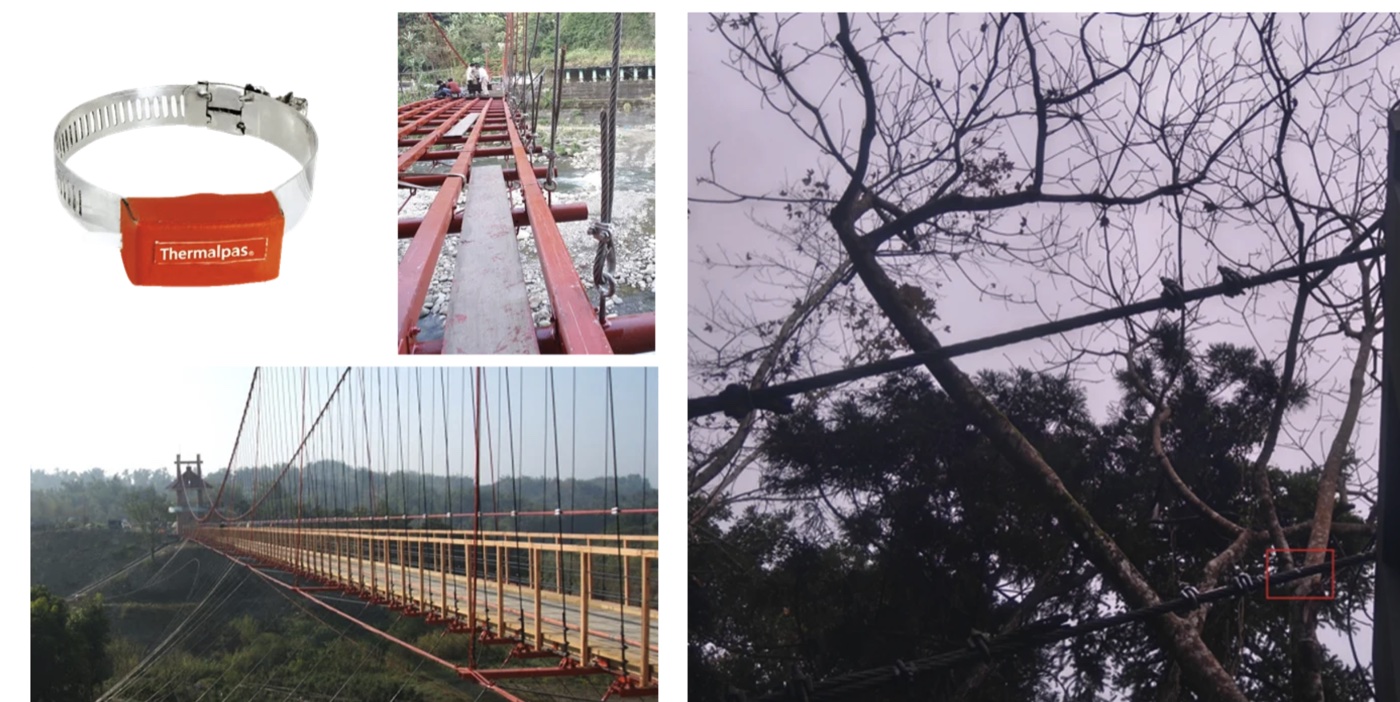
Pipe-Clamp Thermometer — Suspension Bridge Cable Structural Health Monitoring — field installation photo
Public Works Bureau · Transportation

01 The Problem

A suspension bridge cable carries enormous tension. Over decades of use, the steel strands inside the cable slowly fatigue and corrode. Classical structural health monitoring uses embedded strain gauges that are hard to install in an existing bridge and harder to replace. Until now, there was no easy way to monitor cable health continuously after the bridge was built.

The Risk

Suspension cables endure diurnal thermal cycling + wind load + corrosion.

Detection Gap

Internal strand failure must be detected early, but conventional SHM systems cost tens of millions — infeasible for smaller bridges.

02 The OctosX Solution

We use a Thermalpas pipe-clamp thermometer that wraps around the suspension cable from the outside. Tiny temperature changes correlate with internal stress and structural damping. OctosX watches the thermal signature of the cable and flags structural anomalies long before any visible change.

Sensor & Edge

Thermalpas L-TYPE pipe-clamp + strain gauge + OctosX Cloud.

Cloud Logic & Alerting

Cable temperature anomaly = internal friction heat = strand-failure precursor. A low-cost SHM alternative.

03 The Outcome

This is one of the world's first deployments of thermal-tracking sensors for civil structural health monitoring. The data has informed the bridge owner's maintenance schedule and validated a non-destructive way to monitor a heavy civil structure — a model now being studied by other infrastructure owners.

Field Detection

A local-government suspension bridge deployed 24 monitoring points for $600K (traditional SHM: $30M+).

Quantified Impact

50:1 cost advantage, operating 3 years.

See it in your plant

Could this case be your plant?

Tell us about your facility — busbars, motors, panels, coal blowers, chillers, whatever your highest-risk thermal interface is — and we'll show you what an OctosX deployment would look like.