Semiconductor & Hi-Tech AU Optronics

AUO — Floating Solar Panels & DC Combiner Box

Floating solar (over-water PV) combiner boxes face humidity + salt spray + solar radiation.

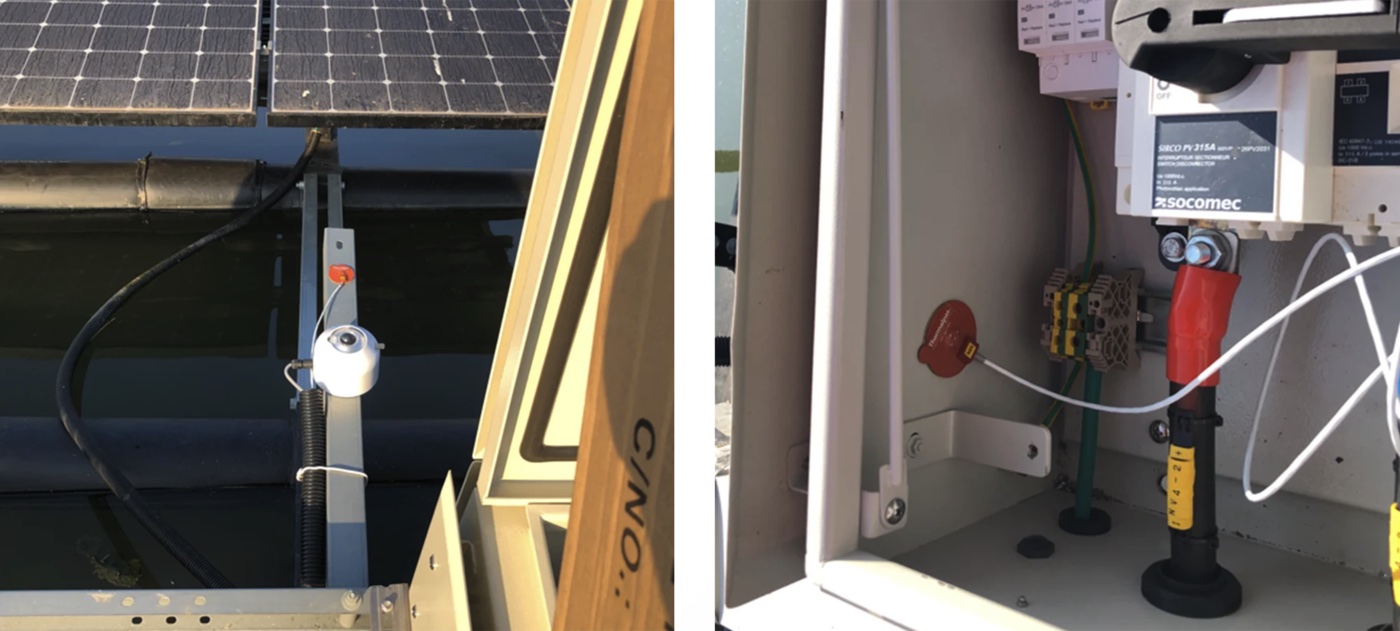
AUO — Floating Solar Panels & DC Combiner Box — field installation photo
AU Optronics · Semiconductor & Hi-Tech

01 The Problem

AUO operates a floating solar farm on a Changbin water reservoir — kilometers of PV panels sitting on plastic floats, baking in the sun and salt spray. Each panel's combiner box has fuse holders and DC breakers that slowly corrode in the humid environment. If a joint degrades enough, you get a DC arc fault. A fire on water is exponentially harder to fight than a fire on dry land.

The Risk

Floating solar (over-water PV) combiner boxes face humidity + salt spray + solar radiation.

Detection Gap

Joint degradation triggers DC arc faults that ignite immediately — fires on water are exponentially harder to fight.

02 The OctosX Solution

We seal Thermalpas IP68 sensors onto every fuse holder and DC breaker. OctosX pulls weather data — temperature, humidity, irradiance — and uses an AI model to distinguish 'normal heat from a hot afternoon' from 'heat that shouldn't be there.' False alarms drop to nearly zero; real faults are caught before the arc starts.

Sensor & Edge

Thermalpas IP68 sensors on every fuse holder and DC breaker.

Cloud Logic & Alerting

OctosX Cloud integrates weather API (temperature + humidity + irradiance), using AI to distinguish "normal load heat" from "fault heat".

03 The Outcome

AUO instrumented 200 combiner boxes at Changbin. Over three years, OctosX caught eight joint degradations before any of them reached arc threshold. The customer believes at least one would have ignited and resulted in a water-borne fire — the kind of incident that ends with regulators on site and a $20M+ bill for environmental cleanup.

Field Detection

At AUO's Changbin floating PV site, 200 combiner boxes were instrumented.

Quantified Impact

Over 3 years, 8 joint degradations were caught pre-arc, averting at least 1 water-borne fire ($20M+ including emergency response and environmental cleanup).

See it in your plant

Could this case be your plant?

Tell us about your facility — busbars, motors, panels, coal blowers, chillers, whatever your highest-risk thermal interface is — and we'll show you what an OctosX deployment would look like.